
We asked about the money.
You set the deposit on each request. They pay by card, or straight to you by payment app. Card locks the time when it's paid. A payment app waits for your confirm. You stay the nice one.
Claim your link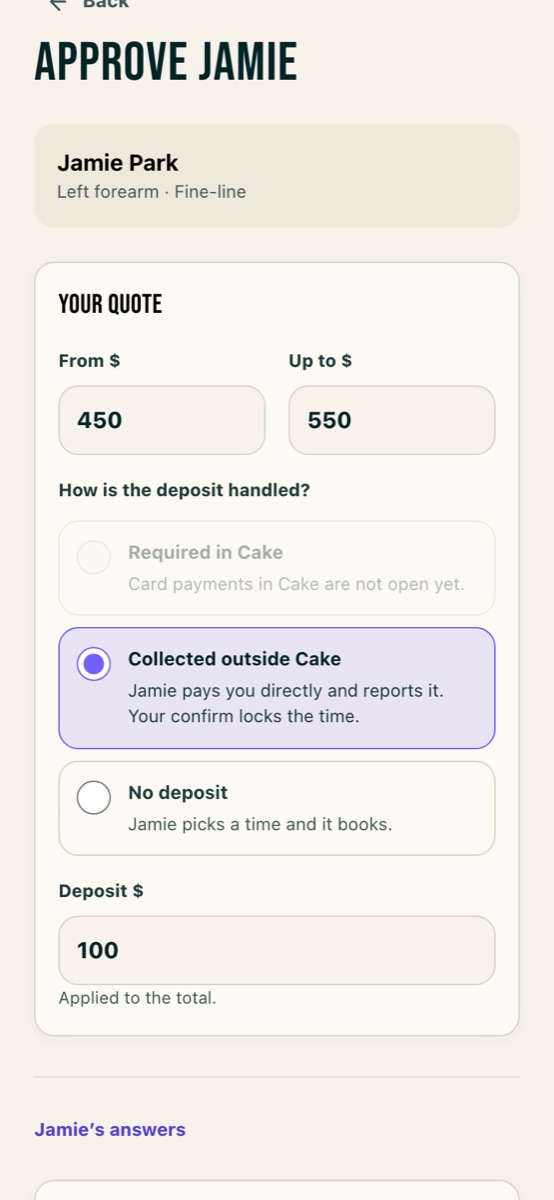
- Deposit received
- Booked
How tattoo deposits work in Cake
In Cake a tattoo artist sets the deposit on each request when they approve it, including no deposit at all. With card payments set up, the client pays by card inside Cake. The client pays the deposit, and Stripe takes its card processing fee from the artist's payout. The time locks when the deposit lands. With a payment app, the client pays the artist by Venmo, Zelle or Cash App with a reference code, and the artist confirms it landed to lock the time. The picked time is held for 2 days while the client pays, and for 2 more days while the artist confirms. The artist can change either window. If either runs out, the time goes back on offer.
Four steps. You do two.
- 1
You set it
On each request, when you approve it. Regulars, trades and friends get what you decide. Zero is a setting too.
- 2
They pay
By card in Cake, or straight to you by Venmo, Zelle or Cash App with a reference code so you can match it.
- 3
You confirm it
A card deposit locks the time when it's paid. A payment-app deposit waits for you: confirm it when it lands, and the time locks.
- 4
Or it goes back
If a payment-app deposit isn't sent or confirmed inside your windows, the time goes back on offer. You set both.
What they see.
-
Your client sees Who to pay, how much, and the code. 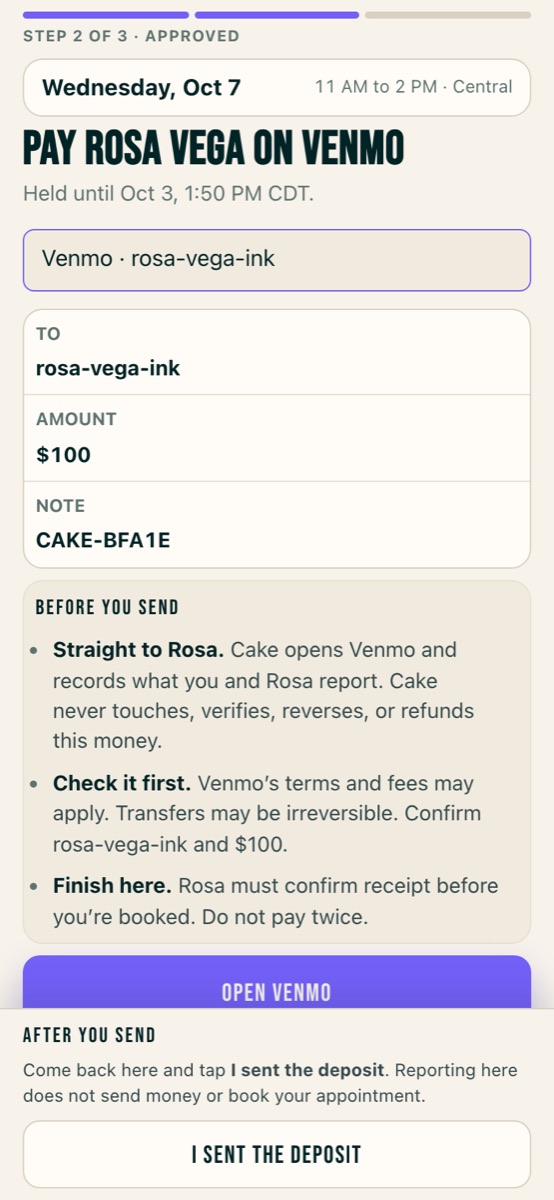
-
Your client sees Held, not booked, until you confirm. 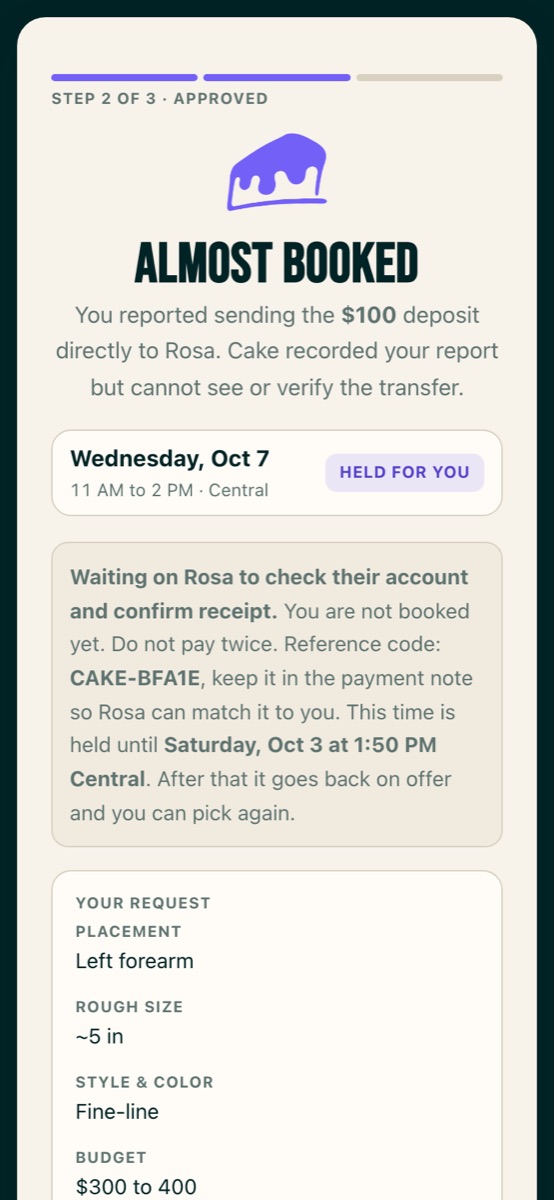
-
Your client sees Then booked. 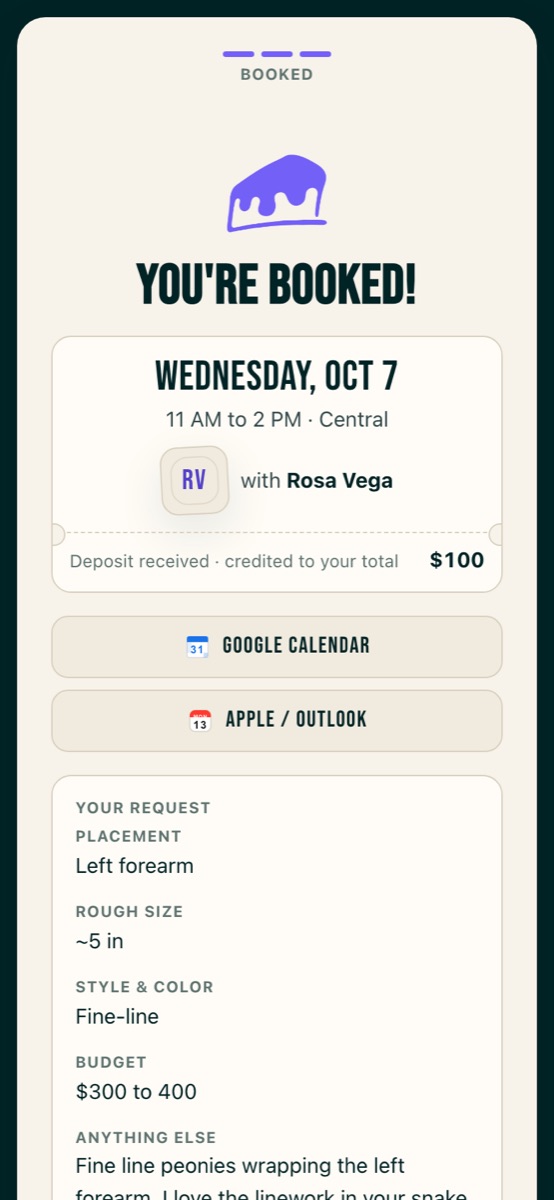
The time waits. You set how long.
With a payment app, the time a client picks is held for them while they pay: 2 days, or the deadline you set. When they say they sent it, you get your own window to confirm it: 12 or 24 hours, 2 or 3 days, or your own number up to 30 days. Confirm it and the time locks. If either window runs out, it goes back on offer.
Clients can pay by card inside Cake. Your client pays the deposit. Stripe takes its card processing fee from your payout. How to turn on card payments. Who pays which fee? Who pays what. Paid by Venmo, Zelle or Cash App instead? Where a deposit stands shows how to confirm it. Need your deposit records at tax time? Read Your card deposits are already organized for tax time.
Sending this to a client? How to book a tattoo appointment is their side of it.
How much is a tattoo deposit?
We don't have a number for you, and we won't invent one. It's your call, and in Cake you set it on each request when you approve it. Zero is a setting too.
What to base it on:
The hours it blocks. A full day takes more of your week than a small flash piece.
The drawing. Custom work takes your time before anyone sits down.
Whether it comes off the total. That's your policy to write.
Who it is. Regulars, trades and friends get what you decide.
A tattoo deposit policy you can copy
Under Settings, then Policies & FAQs, Cake gives you a box each for Deposits, Moving your date and Cancellations, each up to 500 characters. Each draft below fits. Fill in the brackets, cut what isn't how you work, and read it out loud before you save. It's a starting point, not legal advice.
Refund and move-a-date wording
You pick your refund rule in Settings, then Payments, under If a client cancels. When a request has a deposit, Cake writes its line at the top of Cancellations on your page and above the pay button. So leave refunds out of your own Cancellations words. The three rules read like this to clients:
Non-refundable: “[Your name]'s deposits are non-refundable.”
Refundable until a deadline: “Cancel at least [48 hours] before and [your name] refunds your deposit. After that, it's non-refundable.”
Refundable until the session: “Cancel any time before your appointment and [your name] refunds your deposit.” No-shows lose the deposit.
Each request keeps the rule it was approved under, so a change never reaches a client who already paid. The rule tells clients what to expect. It doesn't move money: when you close a request, you still pick Keep deposit or a refund. A card refund goes back to the client's card in full. Refund a payment-app deposit through the app, then press Record refund sent. Cake records it and moves no money.
Moving a date: reschedule from the request. The deposit stays with the session, and your client gets one email with the old time and the new one. Clients can't move it from their page. They message you.
Asked between sessions.
Is a tattoo deposit refundable?
It's the artist's rule. In Cake you pick one in Settings, then Payments: non-refundable, refundable until a deadline, or refundable until the session. Clients read it above the pay button before they pay.
How do tattoo artists take deposits?
Most take them by Venmo, Zelle, Cash App or a card link before the session. In Cake you set the deposit on the request. The client pays by card, or pays straight to you with a reference code and you confirm it to lock the time.
Can I take card deposits in Cake?
Yes. Set up Stripe in Settings, then Payments, and pick Card payments or Both under Deposit. Your client pays the deposit. Stripe takes its card processing fee from your payout. When you refund a card deposit in Cake, it goes back in full, and you cover Stripe's fee. You pick your refund rule in Payments, and clients read it before they pay. Venmo, Zelle and Cash App still work.
Can I book someone without a deposit?
Yes. No deposit is a setting. The client picks a time and it books, unless you turned on I confirm every booking. Then it waits for your yes.
What happens if the deposit never comes?
With a payment app, the picked time stays held for as long as you give clients to pay. It's 2 days unless you set your own deadline. If no deposit is reported by then, it goes back on offer. With card, the time locks only when the deposit lands.